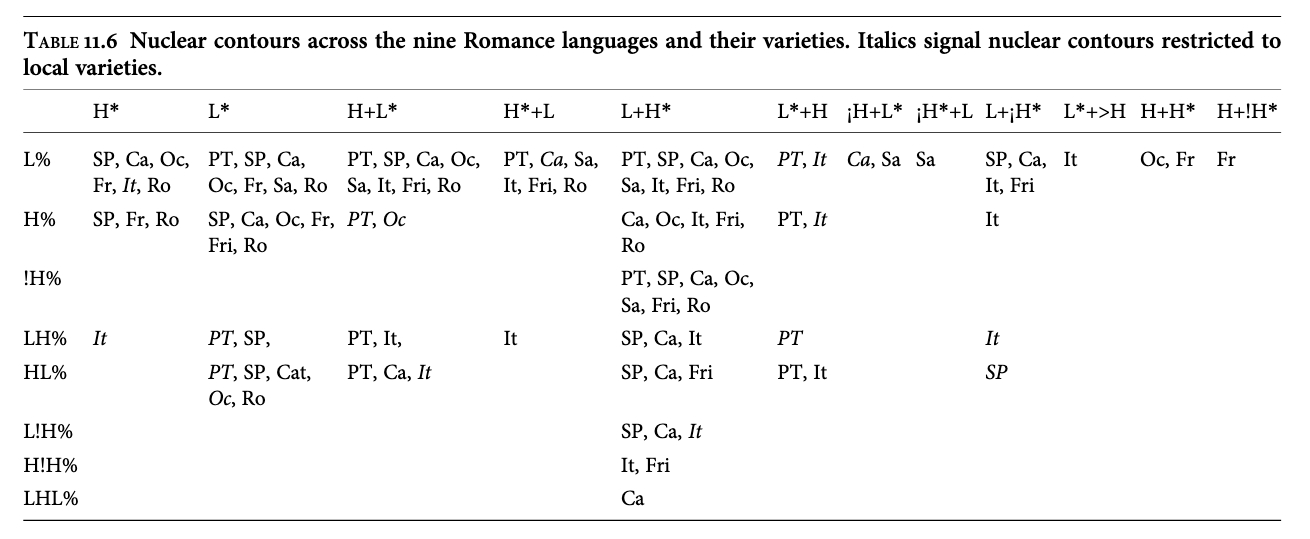
In particular, even early stress typologists (e.g. Hyman 1977) observed that most typological and theoretical work on stress is based on descriptions gleaned from grammars, for which it is plausible, even likely, that the reported stress patterns are based on words uttered in isolation, where the word is equivalent to an utterance. In such cases, the reported stress patterns more accurately reflect phrase- or utterance-level prominence rather than true word-level stress. (Gordon, 2014)
In practice, a study of word-level stress must thus look at words that are not pitch accented and not found in phrasal positions where boundary excursions might give the erroneous impression of stress.
The tonal account of final stress repulsion is particularly attractive given the contrast between the prevalence of reports of penultimate stress and the rarity of descriptions reporting the left edge counterpart to penultimate stress: peninitial stress. Thus, Hyman (1977), Gordon (2002), and van der Hulst and Goedemans (2009) all observe that penultimate stress is substantially more common than peninitial stress in their databases: 77 languages vs. 12 in Hyman (1977), 54 languages vs. 10 in Gordon (2002) and 77 languages vs. 13 in van der Hulst & Goedemans (2009). The asymmetry in the relative frequency of penultimate and peninitial stress also falls out naturally if one assumes that the majority of stress descriptions are referring to isolation forms where the stress is actually a pitch accent. Penultimate stress is common due to the pervasiveness of final boundary tones, in particular, final low boundary tones, whereas the striking rarity of peninitial stress is attributed to the paucity of left edge boundary tones. Antepenultimate stress is also amenable to an explanation in terms of tonal crowding avoidance under the assumption that some languages might deem it preferable to allow an entire syllable, the penult, to intervene between the pitch accent and the boundary tone.
Focus: "ability of peripheral syllables to bear prominence at both the word and phrase level."
Typological classification
While word stress is captured by constituency above the syllable (feet) and above the foot (primary word stress), pitch accents are represented by means of the presence of tones on stressed syllables. Uncontroversially, a representation of the primary and secondary stresses within the word may yield a two-level metrical grid, but the presence of pitch accents is represented in terms of tones as opposed to sentence-level grids. Pitch accent distributions can be described with the help of six generalizations that apply at different levels of the grammar. There is thus no work to be done for a metrical grid or tree in our attempts to capture what determines the location of pitch accents. For that reason ‘prominence’ doesn’t exist in a theoretical linguistic framework. (Gussenhoven, 2015, p. 10)
readings/w7 for one perspective on this)Pitch accents are not the only source of prominence. Pitch excursions associated with phrase edges, especially the right edge, provide another source of pitch movements that potentially contribute to perceived prominence.
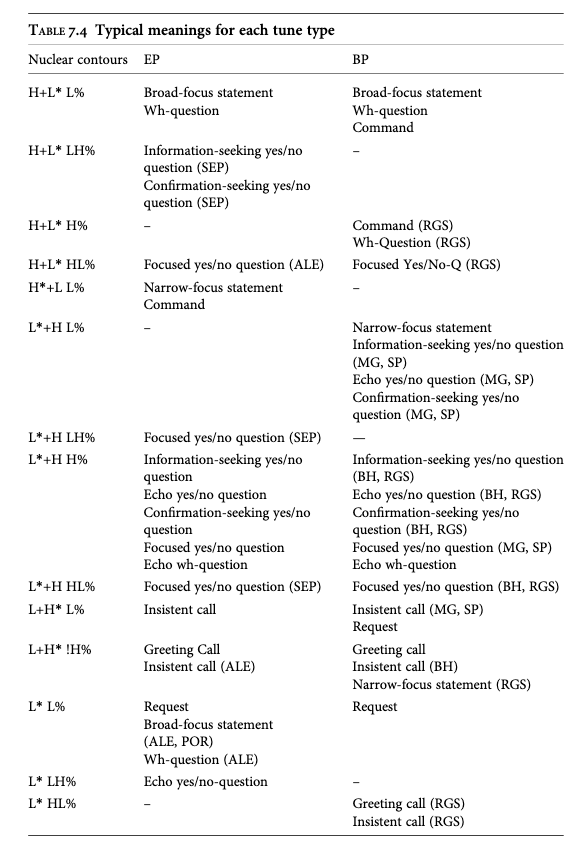
It is significant for the typology of stress that the pitch excursions associated with both Intonational Phrases and smaller phrases may be interpreted as word-level stress for words uttered in isolation, where the word is equivalent to a phrase. Thus, the stress referred to in Fry’s work on English is actually attributed to the combination of pitch accent and terminal pitch excursion characteristic of words uttered in isolation, where the word is equivalent to an Intonational Phrase.
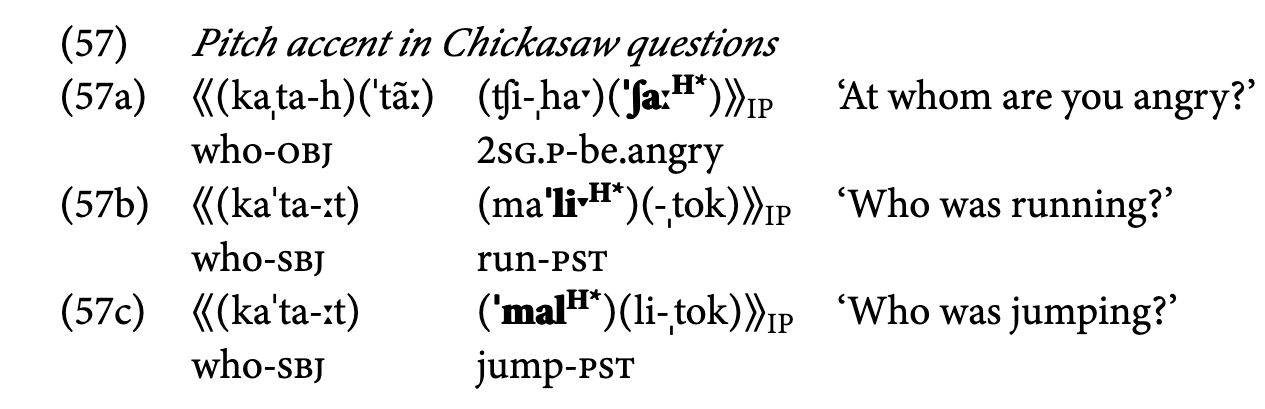
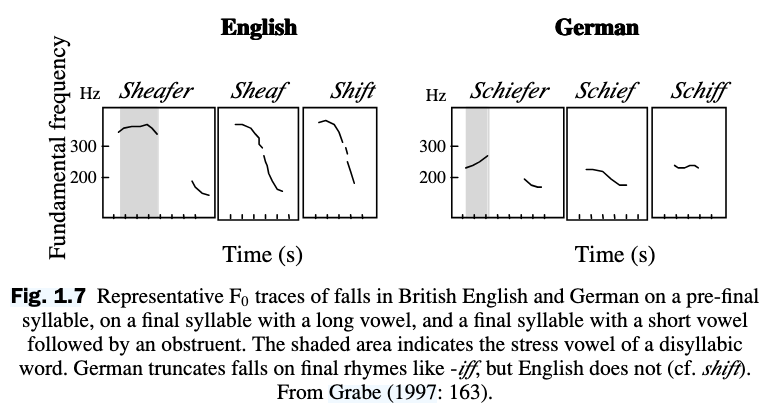
Final pitch accents are particularly vulnerable to edge repulsion since the right edge of phrases is often associated with a terminal pitch fall.
Does that mean in cases where you don't have a fall like a H* L%, you would not expect edge repulsion?
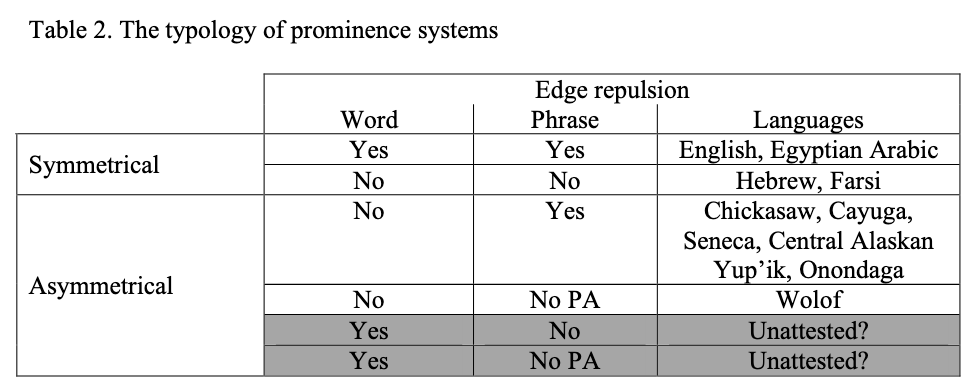
First, some languages will be like English in assigning pitch accents to the same syllable that carries word-level stress. Others will be like Chickasaw in employing orthogonal principles from word-level stress in situating pitch accents. Crucially, in languages of this latter type, only phrasal prominence and not word-level stress is predicted to display edge repulsion effects since the motivating factors behind edge repulsion are only in play at the phrasal level