The frequent displacement of nonutterance-final accentual peaks, which was already noticed by Navarro Tom·s (1974[1944]:49), can now be taken as an established fact of Spanish intonation (Fant 1984, Garrido et al. 1993, Mota 1995, 1997, Llisterri et al. 1995, Prieto et al. 1995, Sosa 1999, Face 2000, Nibert 2000). There is substantial agreement that the displacement of the accentual peak to the posttonic syllable represents the unmarked case for accented words in nonfinal position in declarative sentences. Where there is less agreement is in the phonological analysis of these facts. The question is whether displaced and non-displaced accentual peaks should be given the same phonological representation.” (Hualde, 2002, p. 103)
I would thus propose the label (L+H)* for rising accents in Spanish declarative utterances, both in nuclear and in prenuclear position, without making the phonological distinction claimed by Face (2000). The different alignment between prenuclear and nuclear accents seems to follow from the fact that in the case of nuclear accents there is another low tone that must be realized within the word. This low boundary tone would prevent the dis- placement of the accentual peak towards the right.” (Hualde, 2002, p. 107)
In Gordon (2016)'s slightly more recent Phonological Typology book he gives the definitionss:
In virtually all languages of the world, pitch accents are assigned in “bottom-up” fashion, docking on a syllable that carries primary stress at the word level. (p. 248)
Considerably less common are languages in which pitch accents are assigned based on orthogonal principles to those governing word-level stress with the result that a pitch accent may potentially dock on a syllable that is not necessarily stressed at the word level. (Gordon, 2016, p. 249)
In Chickasaw words without a long-vowel, primary stress (see Chapter 6) falls on the final syllable (and secondary stress docks on non-final CVC) (Gordon 2004a): ˌissoˈba ‘horse’, ʧaˌlakˈkiʔ ‘Cherokee’, ˌokˌfokˈkol ‘type of snail’, tiˈʃo ‘helper to a medicine man’. The final syllable in a statement also attracts a pitch accent: ˌisso ˈbá ‘horse’, ʧaˌlakˈkíʔ ‘Cherokee’, ˌokˌfokˈkól ‘type of snail’, tiˈʃó ‘helper to a medicine man’. In questions, however, the final syllable rejects the pitch accent unless it contains a long vowel. This restriction against final pitch accents means that certain word types receive a phrasal pitch accent on a syllable that is unstressed at the word level. For example, the first syllable in a disyllabic word of the shape CVCV(C) has a pitch accent in questions even though it lacks stress at the word level: e.g. kataːt tíʃo? ‘who is a helper to a medicine man?’ (cf. phrasemedial tiˈʃo pisa ‘s/he looks at the helper to a medicine man’). The English equivalent to this type of pattern would be exemplified by the highly unnatural rendition of the question What devours anteaTÉRS? with a pitch accent on the last syllable of anteaters. (p. 249)
Conditioning placement of accent
Northern Iroquian languages: phrase-final vs. phrase non-final words
Cayuga: from Dyck (2009)
Accent placement makes reference to both edges of the Cwd (Benger 1984, Chafe 1977:175–78, Doherty 1993, Dyck 1997; 1999, Foster 1974; 1982, Hayes 1995, Kager 1993, Michelson 1983; 1988, and Prince 1983). Cwds have a final accent (1a) when they are nonutterance-final (Chafe 1977:170 and Foster 1974; 1982); in contrast, Cwds have a nonfinal accent (1b) when they are in isolation or when utterancefinal. Final accent (1a) is not discussed further, except to note that this type of accent pattern makes reference to the end of the Cwd. (Dyck ~~~~p. 572)
Chickasaw: questions vs. statement have different accent patterns for Intonational-Phrase final position: no final accent for questions (let's look at some examples)
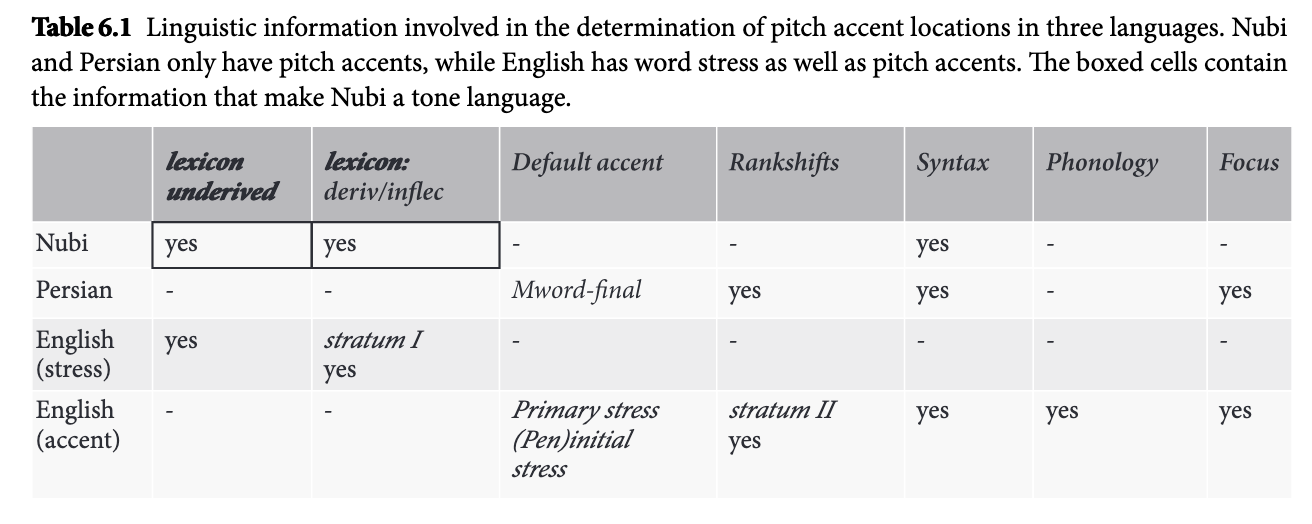
Table from Gussenhoven (2022): we can take a look at the paper for more details
As will be discussed below, I refer to LH and HL tones as “phrase accents” following Grice et al. (2000). Phrase accents behave like boundary tones because they play a role in demarcating the edges of prosodic constituents, but unlike boundary tones in the traditional sense of the term (Bruce 1977; Pierrehumbert 1980), they align with the stressed syllable of the word rather than with the absolute edge of the prosodic constituent. Other examples of edge-dependent phrase accents may include the post-focal accent in European Portuguese (Frota 2000) and the initiality accent in Stockholm Swedish (Bruce 1977; Myrberg 2010).
Stress in Connemara Irish: consistently on initial syllable, but initial stress in Munster Irish (MI) can be "shifted" to a heavy syllable, "maximally the third syllable from the left edge of the word"
Elfner (2015) on stress and accent in CI:
CI (like other dialects of Irish) is a stress language where pitch and tone are used for phrasing and intonational purposes (de Bhaldraithe 1945; Blankenhorn 1981a; Bondaruk 1994, 2004; Dalton and Ní Chasaide 2005a, 2005b). Word-level stress, which falls on the initial syllable with few exceptions (e.g. Ó Siadhail 1989; The Christian Brothers 2004), is thus distinguishable by pitch when it is associated with a phrase accent. (p. 1173)
“Like the fact that CI stress and accent have a common phonetic correlate for both stress and accent but MI does not, the fact that MI displays significantly more stress-accent misalignment than CI, especially in shifted stress tokens, is also important for the discussion of how these phonetic facts support a hypothesis on the diachronic origins of stress shift in MI due to tonal crowding and edge repulsion effects (Gordon 2014)” (Windsor et al., 2018, p. 435)
These are usually defined according to not only (i) their association properties, that is, whether they associate with heads or edges of constituents, but also (ii) their function within the system, that is, whether they are prominence-cueing or demarcative.
Cross-linguistic preferences for relating association properties of tones to their function have led to overoptimization in AM models toward the typical case. This can be a straitjacket for the analysis of new languages and even for the analysis of new phenomena within languages already under investigation. Allowing for tones to have associations to a constituent in the prosodic structure, without necessarily further specifying head or edge association, in addition to separating the association properties from the function, provides a more powerful and flexible tool for the analysis of a wider set of phenomena. (Grice, 2022, p. 65)
To account for these alternations we propose the concept of MELODIC CONSTRUCTION, or MELODY, consisting of the following three components:
• A sequence of tonal primitives (e.g. level or dynamic tones), not necessarily specified as pitch accents or edge tones.
• If not predictable, a set of tonal–metrical association principles for linking these tonal primitives to any given metrical structure in the language.
• A pragmatic specification that may include communicative contextual information (e.g. construction X1 serves pragmatic function Y1 when used in syntactic context Z1; construction X1 serves pragmatic function Y2 when used in discourse context Z2). (p. 12)
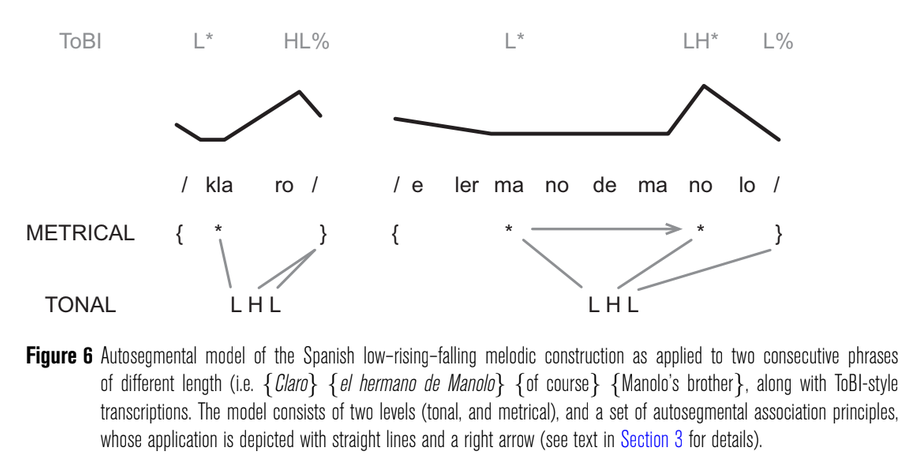
The model includes a tonal tier containing the sequence LHL, a metrical tier contingent on the utterance to be spoken, and the following tonal–metrical association principles:
• The initial tone (L) associates with the first stressed syllable of the phrase, and, in phrases longer than one prosodic word, spreads rightwards up to the last stressed syllable of the phrase. In phrases of one prosodic word only, the condition is not met for spreading, there being only one stressed syllable.
• The second tone (H) associates either, in phrases longer than one prosodic word, with the last stressed syllable of the phrase, or, if the phrase has only one prosodic word, with the right edge of the phrase.
• The final tone (L) associates with the right edge of the phrase. (p. 22)