
w4/ in readingsBennett (2018, p. 23):
...let’s consider a phonotactic restriction discussed by Vogel (2009a; b). In Italian, prosodic words (which correspond roughly to lexical words) cannot begin with the palatal lateral [ʎ] (39). Preverbal clitics like gli /ʎi/ ‘to him’, in contrast, may begin with [ʎ]. These clitics also stand outside the domain of stress assignment for the following verb (Peperkamp 1997: Ch.5). This suggests that preverbal clitics are external to the prosodic word containing their hosts, as they are not subject to the categorical phonotactics which hold in that domain.
(39) Italian: *\([_ω\) ʎ...]
a. libro \([_ω\) libɾo] ‘book’
b. *glibro \([_ω\) ʎibɾo]
c. gli leggevo \([_{CLGR}\) ʎi \([_ω\) leɡːevo]] ‘I was reading to him’Assuming that pre-verbal dative clitics like gli /ʎi/ nonetheless form some kind of prosodic constituent with the following verb, what might that constituent be? Vogel (2009a; b) suggests that it must be the Clitic Group (39c), since the unit in question seems to impose qualitatively different phonotactic restrictions than the prosodic word ω.
Alternative:
(40) Italian: *\([_{ω-MIN}\) ʎ...]
a. *glibro \([_{ω-MIN}\) ʎibɾo]
b. gli leggevo \([_{ω-MAX}\) ʎi \([_{ω-MIN}\) leɡːevo]] ‘I was reading to him’The advantage of this approach is that it accomodates both languages like Italian, in which there appear to be multiple word-level prosodic domains, but also languages like Kaqchikel, which provide strong evidence for a single, recursively-nested prosodic word ω. If recursion is included in our theory of prosodic phonology, as I have argued it must be, then recursive prosodic subcategories (38) should be further explored as a means of analyzing data that has previously eluded an adequate treatment in terms of recursive prosodic structure.
p. 24:
To close, I want to emphasize that the Clitic Group and the recursive prosodic word ω are not extensionally equivalent in their predictions. Only the recursive prosodic word predicts that dependent morphemes (affixes, clitics, etc.) could show the hallmarks of ω-level phonotactics while still remaining outside of the ω of their host or stem. Determinative evidence against the Clitic Group would therefore come from any language in which (i) affixes or clitics provide this kind of evidence for prosodic recursion, and (ii) different levels of the recursive prosodic word ω behave differently with respect to some phonotactic properties, thereby implicating recursive prosodic subcategories over the Clitic Group (see Itô & Mester 2009; Kabak & Revithiadou 2009 for discussion of possible cases of this sort).
For notes on why a Clitic Group analysis of Kaqchikel prefixation is undesirable see Section 3.1 and 3.2.
One key reason is the possibility of multiple prefixes attaching outside the word stem. (Why?)
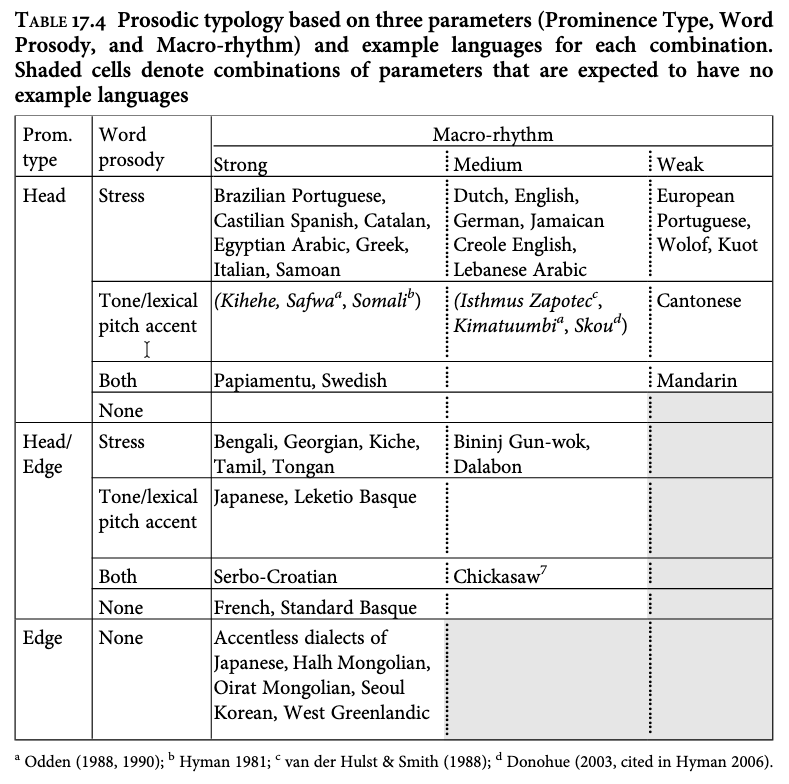
Summary table from Jun (2005: p. 443)
Postlexical prominence:
Postlexical prominence is divided into two categories reflecting the two ways of prominence realization: marking the head (culminative) and marking the edge (demarcative). Head marking is achieved by postlexical or intonational pitch accent, and edge marking is achieved by the phrasal tones marking the edge of a prosodic unit (similar to or slightly higher than the Word level). When the category of prominence for a given language is not agreed upon among the researchers, `(x)' is given.
`Lexical' rhythmic/prosodic unit refers to whether a language is considered to be "mora-timed", "syllable-timed" or "stress-timed" (i.e., foot-timed)---More on this next week!
Postlexical rhythmic/prosodic units tracks which prosodic constituents have been proposed in the analysis of each language
Note: there are a bunch of footnotes below the table I haven't included!
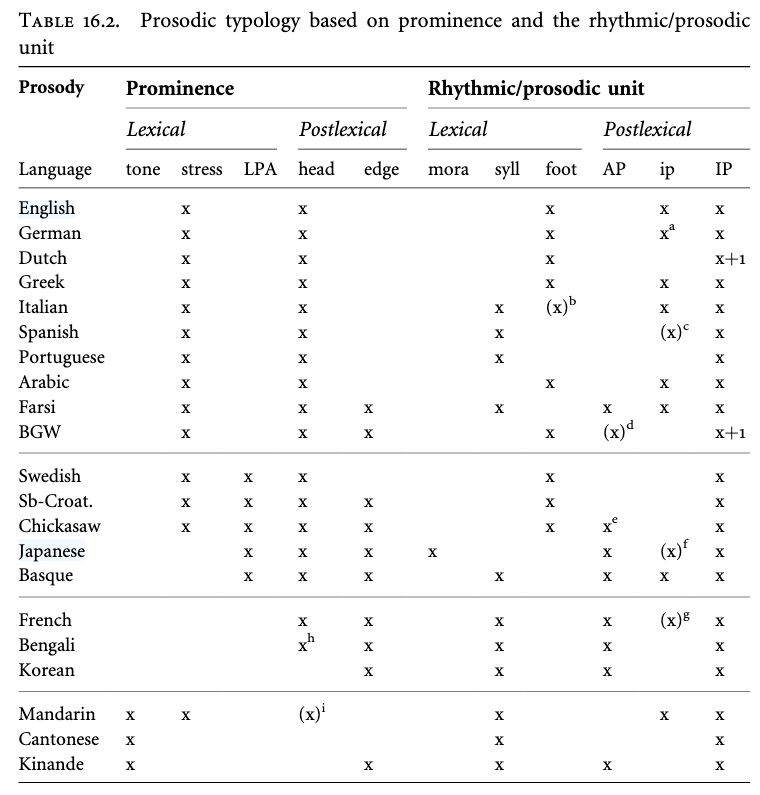
More on postlexical prominence:
Head-marking/culmninatively realized prominence (p. 440)
Prominence is realized culminatively at a postlexical level when a syllable or word becomes prominent through a local manipulation of suprasegmental features such as pitch, duration, and/or amplitude. This is represented as the post-lexical pitch accent (marked as *) in the AM model.
Edge-marking/demarcatively realized prominence (p. 441)
Prominence can also be realized demarcatively at a postlexical level when the prominent word comes at a certain location in a prosodic unit (e.g. the beginning or the end), and a phrasal tone, mostly the same tone type, marks the edge of the prosodic unit. Examples of demarcative prominence are the Prosodic Word boundary tone in Serbo-Croatian (%L), the Phonological Phrase boundary tone in Bininj Gun-wok (Lp), and the Accentual Phrase boundary tone in Japanese (L%) and in Korean (Ha) (see Table 16.2 for more data). That is, the function of postlexical pitch accent in English and other West Germanic languages is preformed by prosodic phrasing in `edge' pro- minence languages.
For example, the function of postlexical pitch accent in English and other Germanic languages (such as marking focus or dis- ambiguating an ambiguous string) is performed by placing words in the same or different prosodic units, i.e., prosodic phrasing, in Japanese and Korean (Ladd, 1996; Venditti et al. 1996; Venditti 2000). Venditti et al. showed that the function of pitch accent and deaccenting in English is delivered by phrasing and dephrasing in Korean and Japanese. In English, contrastive focus is realized by LH* pitch accent followed by deaccenting, while, in Japanese and Korean, contrastive focus is realized by inserting a prosodic boundary before or after the focused word and dephrasing postfocused items (see Jun 1996, 2003a; Jun and Lee 1998; Ueyama and Jun 1998)
Note mention already in Jun (2005):
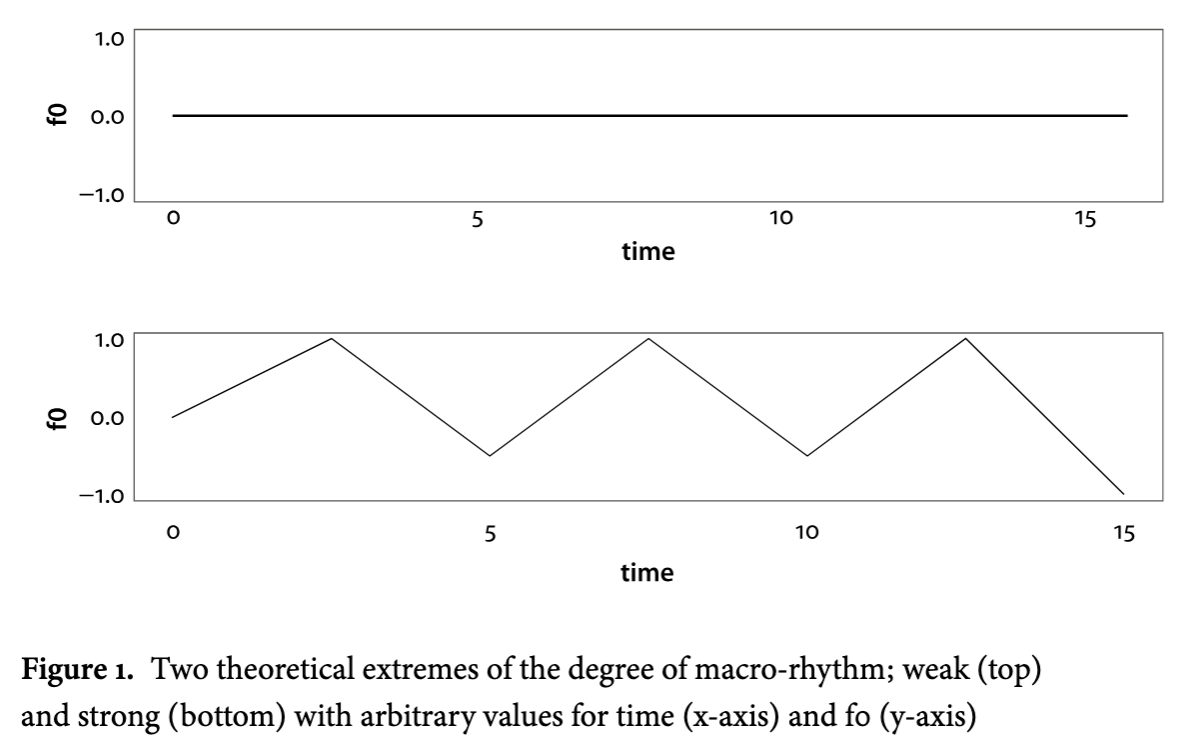
Rhythm is also perceived when a sequence of syllables or words shows a repeating tone pattern (e.g. LLH - LLH - LLH; LHL - LHL - LHL). The grouping of syllables/words marked by a tonal pattern is a postlexical prosodic unit such as an Accentual Phrase or a Phonological Phrase. Rhythmicity will increase if the tonal pattern is the same...The rhythmic patterns derived by the postlexical prosodic unit, which I call a 'macro' rhythmic unit, would vary more than those derived by foot, syllable, or mora, which I call a 'micro' rhythmic unit. (p. 441)
Key idea: what about purely tonal aspects of prosody?
New, revised definition of macrorhythm! (Jun 2014, p. 522)
But, in this revised model, I will narrow the definition of macro-rhythm to the phrase-medial tonal rhythm whose unit is equal to or slightly larger than a word, regardless of whether the tonal pattern is composed of edge tones (i.e. AP or word tones), head tones (i.e. pitch accents or lexical tones), or both. The tonal rhythm of phrases larger than an AP (e.g. IP or ip) is not included because the IP or ip tonal rhythm tends to vary more within a language (due to the variable size of IP or ip) and vary less across languages (for both size and the type of boundary tone).
Three rules:
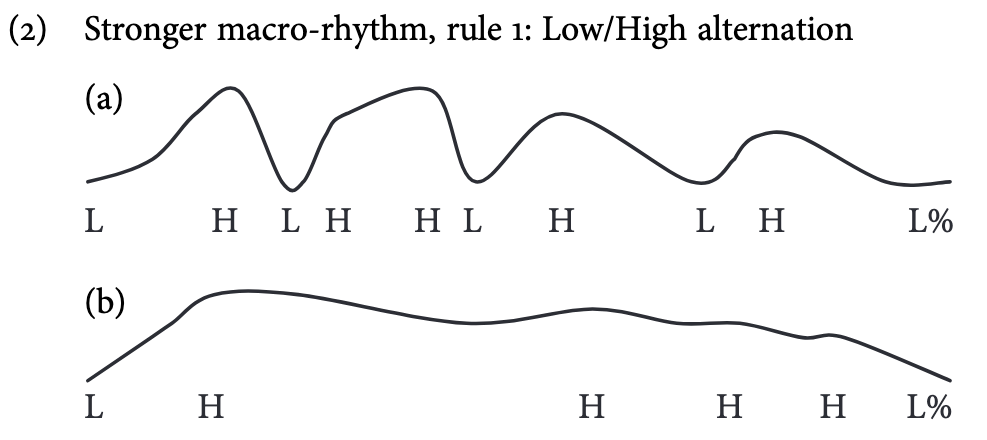
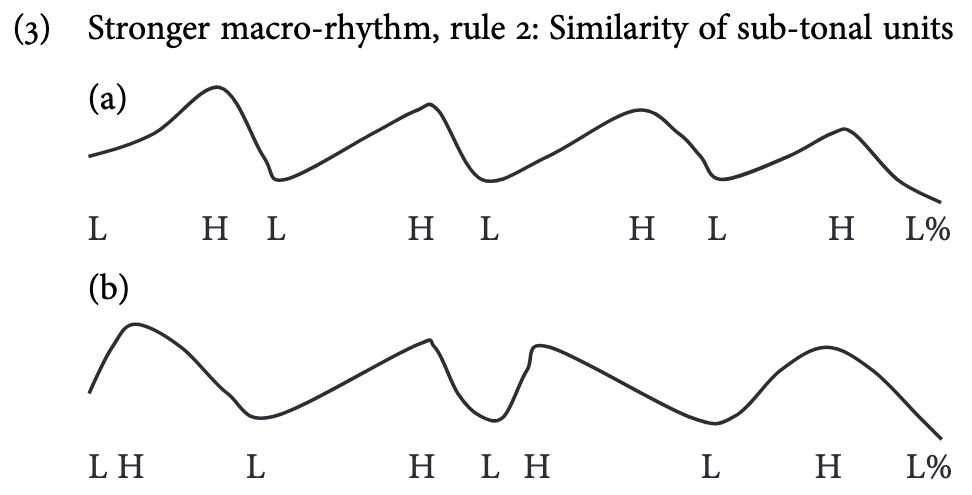
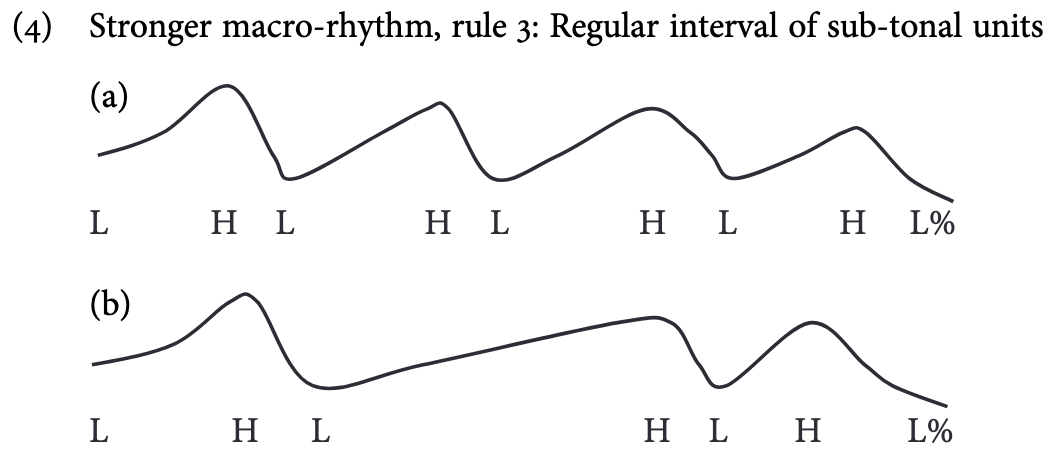
\[ \text{MacR_Var} = SDp + SDv + SDr + SDf \]
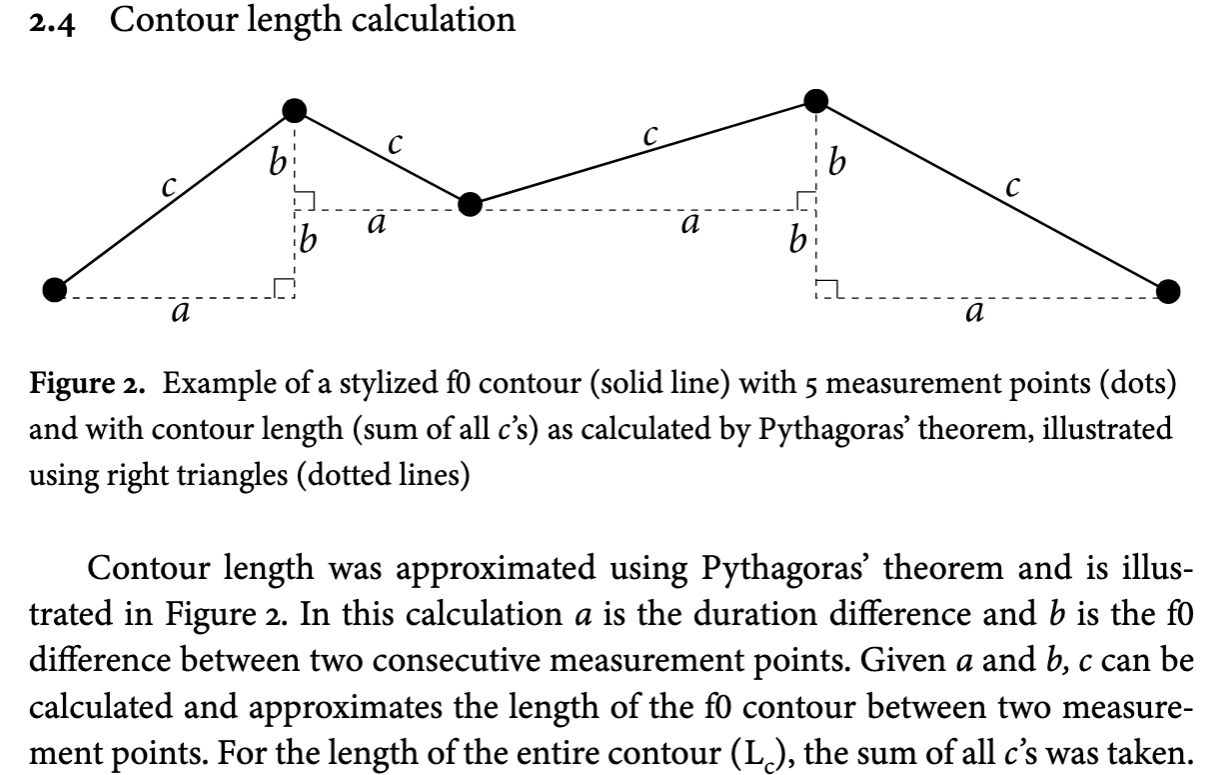
\[ \text{MacR_Freq} = \text{average number of H/L alternations per word (PWd) within a phrase(IP)} \]
In Prechtel (2023) dissertation , p. 19, this is defined as:
\[ \text{MacR_Freq} = \frac{\text{number of f0 peaks per sentence}}{\text{number of PWds per sentence}} \]
w4/ readings
Note caveat in Jun (2014), p. 538-539:
In quantifying macro-rhythm, I have considered the intonation patterns of declarative sentences described in the literature, mostly based on read data. Therefore, it should be noted that the degree of macro-rhythm could change if we add other sentence types or include speech materials produced in different styles of speech. Further research is needed to quantify macro-rhythm across various data.
How regular really are tonal patterns in Korean APs? Check out AP allophonic tonal patterns on K-ToBI page